Radovljica, Ljubljana, Kropa, Kranj: September 13th–20th, 2026
We invite you to gather in front of the pranger, the pillory, for this year’s festival. Once again, it will be the medieval pillory between the pillars of Mali’s House on Linhart Square in Radovljica, the only one of its kind in Slovenia, let us gather and take a peek into the vast worlds of poetry!
The critical section of the Pranger Festival has settled in Radovljica for its 23rd edition, while the children’s programme Mali Pranger – ELA, together with the presentation of the Stritar Award for the best literary critic by the Slovenian Writers Association, has successfully remained in Rogaška Slatina, the birthplace of its namegiving author of children’s literature Ela Peroci and the town where the author and critic Josip Stritar lived and later passed away.
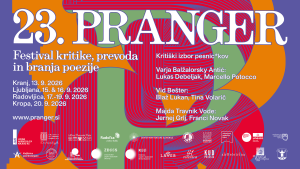
Festival Program 2026
Sunday, September 13th, 2026, Škrlovec Tower, Kranj
17:00, Pranger before Pranger
Guest critic Lara Gobec and her chosen poets: Lara Božak, Blaž Iršič, Alja Adam
Moderation: Hana Bujanović Kokot
In collaboration with Prešeren Theatre Kranj.
Pranger is known as a festival with many branches: from the Youth Pranger ELA for elementary school children, through Pranger Translat for discussion on translations into Slovenian, Pranger Lyrikbook for Slovenian poetry in various foreign languages, to the Young Critics program, where the youngest critics (experience-wise) practice their writing skills under the watchful eye of mentors. In 2025, we expanded the Pranger Festival’s framework program—in the spirit of broadening the scope of criticism—with yet another branch: Pranger before Pranger.
The pre-festival discussion in Kranj takes place apart from the main program. In the latter, a trio of critics discusses their selection of six poetry collections. We complement this format with the perspectives of those who are already expressing their views on literature and whom we would therefore like to invite to take it a step further—onto our pre-festival stage. Pranger before Pranger invites a young critic to present their selection of three poetry collections published last year that deserve public discussion.
This year, Lara Gobec will be joining us, and her selections are: Kap lje kap lje by Lara Božak (Pivec Publishing), Parada heteroseksualcev by Blaž Iršič (LUD Literatura), and Pes, dvojčici in zeleni tatu by Alja Adam (Center for Slovenian Literature). The event will be hosted by Hana Bujanović Kokot.
19:00, Pranger x Vilenica
Presentation of the Slovenian guests of the Vilenica Festival: Ana Marwan, Natalija Milovanović and Stefan Feinig
Moderated by: Urška Bračko
In collaboration with the Slovene Writers’ Association and Vilenica Festival.
***
Tuesday, September 15th, 2026, Center for Architecture Slovenia, Ljubljana, 18:00
Conceptual debate Poetry & Iron
Guests: Prof. Dr. Irena Novak Popov and Tch. Asst. Aleš Gabrijelčič
Moderated by: Asst. Prof. Dr. Ana Svetel
In collaboration with the Center for Architecture Slovenia.
How do something as tangible and natural as the element iron, Fe, and something as intangible, artistic, and transcendent as poetry relate to one another—and in what ways do they differ? Pranger’s conceptual debates are known for their seemingly incompatible pairings: Poetry & Sports, Poetry & Stench…
This year, we ask ourselves what, if any, structural elements unite and separate poetry and iron. Ambiguity in meaning and in form: iron as a building material, as a building block of railroads that carry people into the distance and across vast expanses, just like poetry. Iron as a building block of blood cells in the body, a source of strength and power, in the circulatory system and, historically speaking, in the economy. Poetry as a bearer of strength and spiritual and ethical integrity. The iron will of an upright position and its opposite: the softness of expression. For example, without iron and his ironworks, along with his workers, Žiga Zois could not have been the patron of Slovenian national poetry in the 19th century.
The theme of poetry and iron, which we will introduce with a conceptual debate, will be a recurring thread throughout this year’s festival. We will pillory and discuss a variety of questions, ranging from the fragility of time to the solidity of opinions, and on the festival’s final day, we will also focus on the local history of ironworking in Kropa. As the museum blacksmiths at the historic Vigenjc Vice Forge will attest, poetry and iron are thus rare resources that must be carefully extracted from nature with respect for the environment.
Wednesday, September 16th, 2026, bookstore Pri kamniti mizi, Ljubljana, 18:00
Pranger Poetry Reading
Poets: Tina Volarič, Blaž Lukan, Franci Novak, Lukas Debeljak, Marcello Potocco
Moderated by: Natalija Milovanović
Despite annual innovations such as the new collaboration with the Vilenica Festival, the new format Pranger Before Pranger in Kranj, and the accompanying program Kropa: Museum Town, Pranger maintains certain traditions over the years. One such tradition is the grand poetry reading in Ljubljana, where this year’s group of six poets, selected by Dr. Varja Balžalorsky Antić, Majda Travnik Vode, and Vid Bešter, will introduce themselves to the audience. Before we turn our critical attention to the books in Radovljica, we’ll listen closely to their readings in Ljubljana. At the Pri kamniti mizi bookstore, Tina Volarič, Blaž Lukan, Franci Novak, Lukas Debeljak, and Marcello Potocco will share their work. Jernej Grlj will be with us in spirit and through his books, as you’ll be able to purchase all six chosen collections at the smallest bookstore in Šiška. The reading will be moderated by Natalija Milovanović, co-director of the Pranger Festival. The event will be followed by a sweet surprise and a small reception.
The event will also feature the exhibition Books in Clothing created in collaboration with the Maribor Woodworking School. For this occasion, last year’s Pranger collections will be given unique wooden covers crafted by Maribor high school students. The Books in Clothing will be on display at the The Slovene Days of Books Festival in Maribor, the Pranger Festival, at the school itself, and at the Selnica ob Dravi Cultural Centre. The collections of this year’s festival will receive their “bark” next fall; until then, let thoughts about them continue to grow and branch out…
***
Thursday, September 17th, 2026, Radovljica
13:00, Šivec House Gallery Radovljica: Visit Radol’ca Welcome Reception and opening of the Gorenjska part of the festival: exhibition Books in Clothing, musical performance by Boštjan Soklič, Tantadruj
In collaboration with the Radovljica Municipality Museums, Anton Tomaž Linhart Library Radovljica, and the Maribor Woodworking School.
15:00–18:00, Anton Tomaž Linhart Library, 1. critical debate
- Franci Novak: Zgodbe o tebi, chosen by Majda Travnik Vode
- Tina Volarič: Nekje notri je uho, chosen by Vid Bešter
- Moderated by: critic Diana Pungeršič
19:00, Anton Tomaž Linhart Library, rooftop terrace, meet and greet
Friday, September 18th, 2026, Radovljica
9:00, Anton Tomaž Linhart Library, lecture The Prešerens
Presented by: Jure Sinobad
Second day in Radovljica begins with a lecture on the Prešeren family’s legacy in Radovljica. Historian mag. Jure Sinobad will present the impact that various members of the old Gorenjska peasant family, the Prešerns, had on the region below Stol from the 15th to the 20th century. They quickly rose up the social ladder, including Janez Krstnik Prešeren, Count Palatine. According to written sources, the first Prešeren attested in documents was mentioned in 1441 and was a native of Radovljica. The exhibition and its complementing book, which are the result of a quarter-century of research, were created in collaboration between Stane Adam and Jure Sinobad to mark the 225th anniversary of the birth of the greatest Slovene poet, France Prešeren.
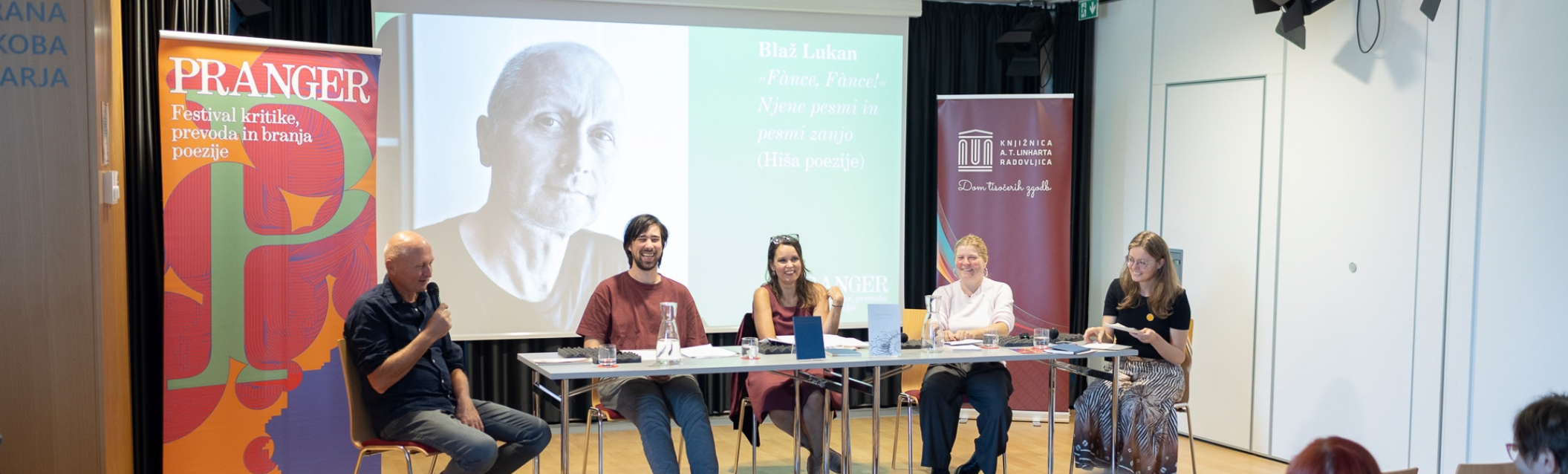
10:00–13:00, Anton Tomaž Linhart Library: 2. critical debate
- Blaž Lukan: »Fànce, Fànce!« Njene pesmi in pesmi zanjo, chosen by Vid Bešter
- Lukas Debeljak: Drevo, ki ga pišemo nihče, chosen by Varja Balžalorsky Antić
- Moderated by: critic Diana Pungeršič
16:00–17:00, Architectural and Literary Tour: Radovljica. A Space of Freedom:
Led by: Janko Rožič
Architect, urban planner, and essayist Janko Rožič will present unique perspectives and insights into the architecture and nature of Radovljica during a walk through the historic center. Drawing on the latest findings in the field of spatial planning, he will explore the ancient wisdom of spatial design, which the old masters and our ancestors constantly harmonized with nature. They harmonized, not advertised, which is why traces of their work have stood for centuries. “Space of Freedom” is Janko Rožič’s key architectural and philosophical principle. True space is not limited by walls or fences; rather, the very name space implies a place from which the simplicity of living emerges. Rožič put this philosophy into practice in several groundbreaking projects across Slovenia, the best known of which is the Hostel Celica (Ljubljana). In collaboration with artists, he transformed the former austere Austro-Hungarian military prison into an open cultural center and a vibrant haven. His key challenge was how to transform a closed prison into an open “space of freedom.” His ideas emphasize that space should be understood as an intersection of various fine arts—architecture, sculpture, and painting—and as a space that fosters dialogue, freedom, and creativity, rather than limiting people with narrow interests.
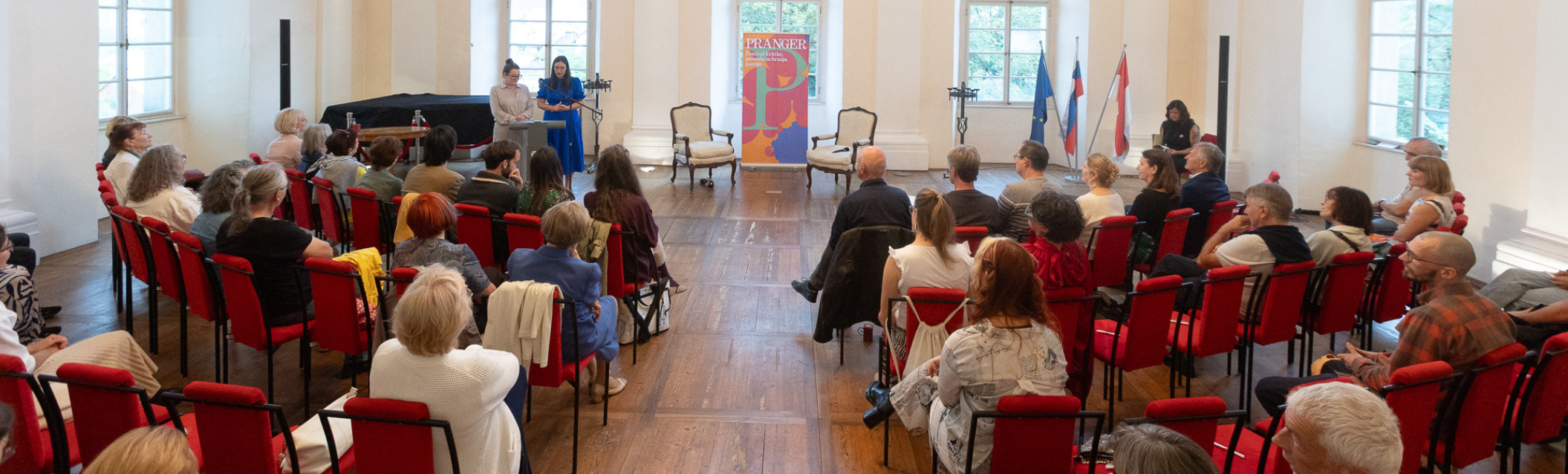
18:00, Baroque Hall in the Radovljica Manor: Poetry & dance & gathering at the pillory
Poetry by the Pranger poets, in collaboration with dancer Kaja Lin J. Avguštin, who will create dance vignettes. The language of movement, breath, hesitation, and transitions in dialogue with poetry.
Moderated by: Katja Bevk
Pranger has joined forces with dancer and choreographer Kaja Lin Jagodič Avguštin, whose artistic expression is characterized by a strong physical presence, poetics, and a subtle exploration of inner states. Her dance does not tell stories in a linear manner, but rather opens up spaces of sensation, tension, and silence that can also arise between verses. Her presence will not simply accompany the poetry, but will form a sort of parallel current—a body that listens, resonates, and sometimes continues what the poem merely hints at. In dialogue with the word, a different language emerges: the language of movement, breath, pauses, and transitions.
Saturday, September 19th, 2026, Radovljica
9:00, Anton Tomaž Linhart Library, guided tour and the 120th Anniversary of the Library
Led by: Katja Bevk
10:00–13:00, Anton Tomaž Linhart Library: 3. critical debate
- Marcello Potocco: Dnevnik zelene premičnice, chosen by Varja Balžalorsky Antić
- Jernej Grlj: Tišina, chosen by Majda Travnik Vode
- Moderated by: critic Diana Pungeršič
15:00–16:00, Pranger for Hikers: guided tour along the Lamberg Trail
Starting point: Krpin parking, Begunje na Gorenjskem, from Krpin valley through Zijavka Cave to Kamen castle
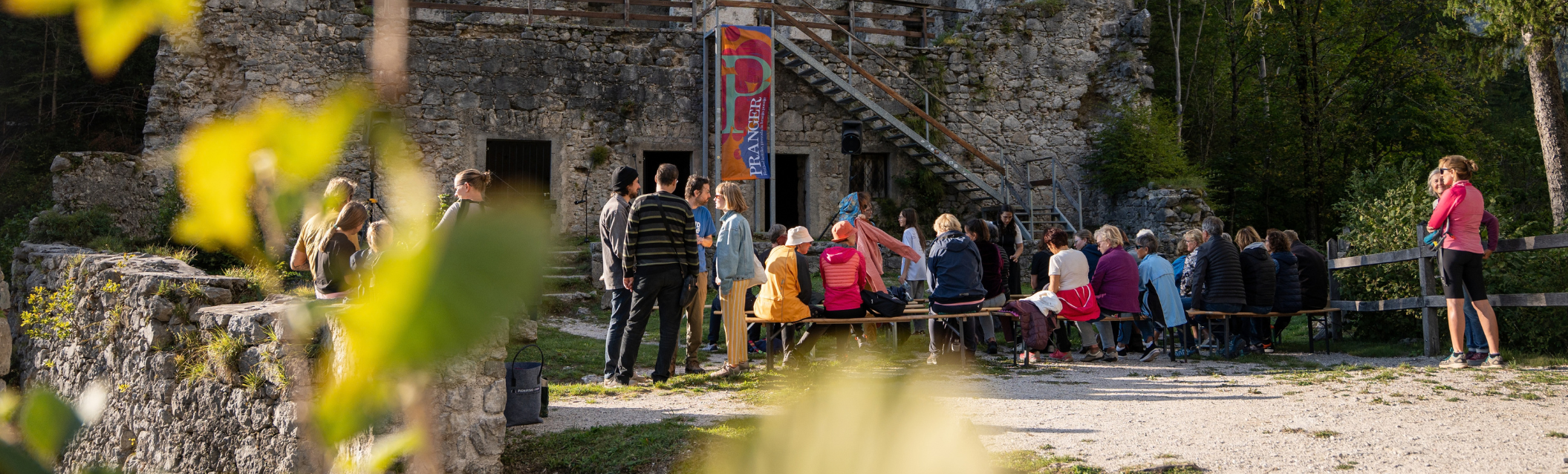
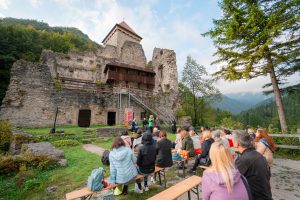
17:00, Kamen Castle: Pranger x Lamberg – ambiental reading
Poets: Franci Novak, Lukas Debeljak, Marcello Potocco
Music: Gašper Primožič & Tomaž Štular
Opening speech: Božena Kolman Finžgar and Peter Kolman
Moderationa and storytelling: Katja Bevk
Interactive food stand, Mateja Reš: Flowers and Iron
If you’re in the mood for a hike after Saturday lunch, we invite you to join a local guide on the Pranger for Hikers! Following the Lamberg Trail from Krpin valley through the Zijalka cave, you’ll discover the rich history of the castle, which was home to several noble families over the centuries. Among them, the best known is the Lamberg family; the local knight, Gašper II Lamberg, was one of the most famous tournament warriors of his time. At the fascinating ruins of the Lamberg family’s Kamen Castle, after all three discussions and the hike, we’ll treat ourselves to some relaxed reading in nature. The event will begin with a welcome address by our guest of honor, Božena Kolman Finžgar, a longtime advocate for culture in Radovljica; we’ll hear a fairy tale about a dragon and the dwarf Blacksmith, along with musical accompaniment by opera soloist Tomaž Štular and accordionist Gašper Primožič.
The reading will be followed by an interactive taste of “flowers and iron” prepared by the owner of the Reš organic farm and garden center, who supplies her delicacies to numerous restaurants, including Michelin-starred venues. She will select and prepare iron-rich dishes for Pranger; as we cook, we’ll discover which plants contain more iron than we realized, and the resulting meal will provide us with energy to carry us through the evening.
In collaboration with Begunje Tourist Information Centre.
***
Sunday, September 20th, 2026, Kropa
09:30–11:15, Kropa – Museum Town: guided tour, ironwork
11:30, Main Hall of the Kropa Cultural Centre, The Speechsmith’s Workshop: On the Kropa Dialect in Theory and Practice
Led by: Anže Habjan (Kropa Cultural Society), dr. Jožica Škofic (The Research Centre of the Slovenian Academy of Sciences and Arts), Metka Kavčič (Radovljica Municipality Museums).
Conducted by: Suzana Adžić (Kropa Cultural Society)
In collaboration with the Municipality of Radovljica, the Radovljica Municipality Museums, and the Kropa Cultural Society
13:30, Pri Jarmu restaurant: closing lunch and a farewell until next year
This year’s theme is ironworks-inspired Poetry & Iron. Starting with the conceptual debate in Ljubljana, the fairy tale about the ironworking dwarf in Begunje, and forged gifts, all the way to the heart of iron forging in the Radovljica municipality: on the festival’s final day, we’ll head to Kropa. We will visit the Iron Forging Museum and the historic vigenjc Vice forge, where everyone will have the chance to try their hand at iron forging. We’ll also take a walk to the Fovšaritnica House, a traditional iron forger’s house, and—while strolling through Kropa—we can’t miss another important birthplace.
We will pillory a variety of questing, ranging from the fragility of the times to the solidity of opinions.
This year, Pranger’s concepts will also be interwoven with dialectology. “The Speechsmiths’s Workshop,” featuring Jožica Škofic PhD and Anže Habjan with his Folk Theater and the Kropa Cultural Society, will conclude the gathering of iron and poetry beneath the late-Medieval blast furnace (Slovenska Peč).
Foreign language in focus: Slovak
Stanka Repar is returning to the Pranger Festival for the fourth time in 2026. She first attended as a poet in 2015, then as a critic in 2016 and 2017, and this time she is joining as a translator—of poetry—into Slovak. She wrote the following about her work:
Six authors (including only one female author) fell into my lap like six ripe pears from Pleterje, each with a different flavor, sweetness, appeal (to wasps), texture, and even shape. As an explorer of philosophical-romantic landscapes in the work of Lukas Debeljak, proto/post/historical echoes in the work of Marcello Potocco, animal mysteries in the work of Tina Volarič, spiritual-metaphysical reverberations in the work of Jernej Grlj, existential-relational structures in the work of Franci Novak, and old-fashioned family stories in the work of Blaž Lukan, I have delved into that which has no fixed parameters—into poetic infinity. However, as a translator from Slovenian into Slovak, I found myself in what I could only call “difference.” All in all—a demanding yet joyful endeavor.
October
Young critique: literary criticism workshops with Silvija Žnidar. Applications for the Young Critics workshop, mentored by Silvija Žnidar and taking place in October and November, are open until September 5, 2026. Apply at: kreativa@pranger.si. During the workshop, you will critically analyze one of the collections from Pranger’s central critical selection of six books (Lukas Debeljak, Jernej Grlj, Blaž Lukan, Franci Novak, Marcello Potocco, Tina Volarič). To apply, please send us an email with a brief résumé.
The critics’ choice 2026
- Lukas Debeljak: Drevo, ki ga pišemo nihče (LUD Šerpa, Ljubljana)
- Marcello Potocco: Dnevnik zelene premičnice (Hiša poezije, Ljubljana)
- Blaž Lukan: »Fànce, Fànce!« Njene pesmi in pesmi zanjo (Hiša poezije, Ljubljana)
- Tina Volarič: Nekje notri je uho (Založba Goga, Novo mesto)
- Jernej Grlj: Tišina (Celjska Mohorjeva družba, Celje)
- Franci Novak: Zgodbe o tebi (Hiša poezije, Ljubljana)
In its day, the “pranger” was a pillory set up in the middle of the town square, onto which criminals were tied. Its purpose was public punishment, in which the townspeople could participate with their remarks and comments.
With the Pranger Festival, the Pranger literary society nurtures criticism, translation and reading of poetry. Pranger Translat is dedicated to the reflection of various forms of translation. ELA – Little Pranger is devoted to fostering creativity and providing cultural and artistic education to schoolchildren, while Pranger Lyrikbook brings contemporary Slovene poetry into an international context.
At the Pranger festival, where poets, critics, and translators gather every year, we do not indeed pillory anything. Quite the opposite, we put poetry on a pedestal. The aim is not to shame, but to critically evaluate poetry — both Slovenian and internationa l— and to bring it closer to the people. Through conceptual and critical discussions using poetry as a tool, we explore the possibilities of poetry while also examining Slovenian poetry collections published in the previous year that, according to expert opinion, are most deserving of discussion. We also offer a platform for translators and poetry critics, many of whom gained their first experience right here at this festival. Part of the program is also dedicated to children, as well as college and high school students.
The event is part of a program of literary events co-funded by the Slovenian Book Agency (JAK).
23. Pranger 2026 Acknowledgments: Slovenian Book Agency, Anton Tomaž Linhart Library Radovljica, Tourism and Culture Radovljica, Radovljica Municipality Museums, Center for Architecture Slovenia, Vodnik Homestead Ljubljana, Ljubljana Unesco City of Literature, Begunje Tourist Information Centre, Library Under the Treetops, Prešeren Theatre Kranj, Kropa Cultural Society, Municipality of Radovljica, 41. Vilenica, Poiesis, The Federation of Associations of the Blind and Visually Impaired of Slovenia, Minka Skaberne Library for the Blind and Visually Impaired, Maribor Woodworking School, Radovljica Early Music Society, Airbeletrina, Kolman foto, video & aerial, Mateja Reš Garden of Tastes, 44. Radovljica Festival, Radovljica Music School, Layer House Kranj.
19. Little Pranger – ELA and Stritar Award 2026 Acknowledgments: Municipality of Rogaška Slatina, Slovenian Book Agency, Rogaška Slatina Library, Tourism and Culture Society Rogaška Slatina, Slovene Writers’ Association, IBBY Slovenija, Anin dvor Rogaška Slatina.